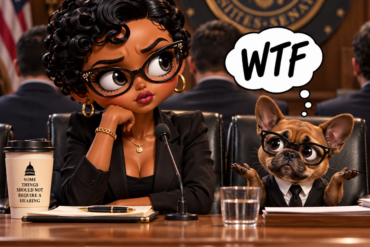
The Trump-a-Palooza empty seats in Dallas were not necessarily the political disaster everyone assumed. Perhaps the chairs were practicing social distancing. Perhaps the upper deck had been reserved for invisible patriots. Perhaps thousands of supporters were outside, as President Trump claimed, patiently declining the opportunity to enter a building containing thousands of available seats.
Anything is possible when a crowd-size report becomes a creative-writing exercise.
THE SOLD-OUT EVENT WITH ROOM TO STRETCH
Before the Republican midterm convention began at Dallas’s American Airlines Center, Trump declared it sold out. Once he reached the stage, he announced that the arena was packed and that an equal number of people were standing outside. This was a remarkable statement to make while the empty upper decks were sitting behind him, minding their own business and appearing on camera.
The venue holds roughly 20,000 people. Reports from inside described large portions of the upper level as empty and stretches of side seating as sparse. The crowd grew before Trump spoke, but “more people arrived” and “the building was packed” remain two entirely different sentences.
Then people started leaving before the speech ended. By the ninety-minute mark, reporters could see the departure happening. Trump continued for 106 minutes, which was considerably longer than the scheduled forty-five. A person can support a political movement and still have parking fees, lower-back pain and a firm bedtime.
THE BATHROOMS HAVE BEEN CALLED AS WITNESSES
Trump had an explanation for the visible gaps: people were in the bathroom.
This would mean the American Airlines Center experienced a synchronized bladder event of historic proportions. Entire sections apparently stood up at once and marched toward the toilets just as the cameras began counting chairs. Nobody alerted FEMA. Nobody distributed cranberry juice. The nation simply carried on.
He even asked people not to leave for the restroom because someone else might take their seat. This warning would have carried more weight if the audience had not been surrounded by seating opportunities.
The Trump-a-Palooza empty seats were not hidden in a mysterious annex. They were in the arena. Reuters observed empty upper decks and sparsely filled side sections. Other reporters inside saw the same thing. This was not advanced political analysis. It was the ancient investigative technique known as looking around.
EVEN THE GIANT SCREEN TRIED TO LEAVE
The production itself joined the rebellion. The giant screen behind Trump began glitching and flashing images from earlier speakers. It looked less like a national political convention and more like the television in a hotel room after somebody sat on the remote.
The convention had been designed as a grand display of party strength ahead of the midterms. Instead, it offered a partly empty arena, technical trouble and a speech that kept walking long after the clock had called an Uber.
Several Republican lawmakers stayed away. Party officials reportedly struggled to fill delegate seats. Major broadcast networks declined to carry the entire spectacle. Yet the official story remained enormous demand, overflowing crowds and unmatched enthusiasm.
This is the problem with building politics around spectacle: eventually, the camera pulls back.
A CHAIR DOES NOT KNOW HOW TO LIE
A politician can rename an event. A campaign can crop a photograph. A speaker can insist that thousands of people are standing beyond the walls. But an empty chair remains an empty chair. It has no consultant, no talking points and no interest in protecting anybody’s ego.
The Dallas convention still drew loyal supporters. Trump still received cheers. None of that requires pretending the vacant sections were a mass pilgrimage to the restroom. A crowd can be enthusiastic without being full. A rally can happen without becoming the greatest gathering in recorded civilization.
But ordinary descriptions do not survive well inside the Trump universe. Everything must be the biggest, the first, the most successful or the most unfairly attacked. Reality is permitted to attend only after signing a nondisclosure agreement.
So I am not calling the Trump-a-Palooza empty seats a catastrophe. I am calling them evidence. The performance said sold out. The photographs said sit anywhere.
Trump could blame the bathrooms, praise the people supposedly waiting outside and keep declaring the arena packed. None of it changed what the cameras captured: rows of chairs sitting through the speech more faithfully than some of the invited guests.
That is the trouble with building a political movement around spectacle. Eventually the lights come up, the camera pulls back and the empty space starts speaking for itself.
Apparently everybody had somewhere else to be. And for once, the empty seats told the truth before the politicians did.
——Kimberly