
America and Canada have decided that peace is overrated when there are appliances, cheese, and household essentials available to be drafted into a trade war. Trump tariffs Canada with a staggering 50% duty, and Canada — the country whose national sport involves apologizing after body-checking someone — looked back and said, “Oh, you wanna play? Here’s your tariff.”
Let that sink in. Two countries that share the longest unprotected border on Earth — a border so friendly that people used to just walk across it to buy cheaper prescription drugs and better poutine — have now reached the diplomatic equivalent of a reality-show reunion where somebody definitely flipped a table, and now everybody’s standing around pretending they didn’t see the cheese platter hit the floor.
How Trump Tariffs Canada Turned Allies Into Economic Rivals
The Trump administration, in its infinite wisdom, looked at Canada and said, “You know what this relationship needs? Fifty percent tariffs.” Not ten. Not twenty. Fifty. That’s not a tariff rate; that’s a divorce settlement negotiated by someone who just found out their spouse was hiding a secret family in Saskatchewan.
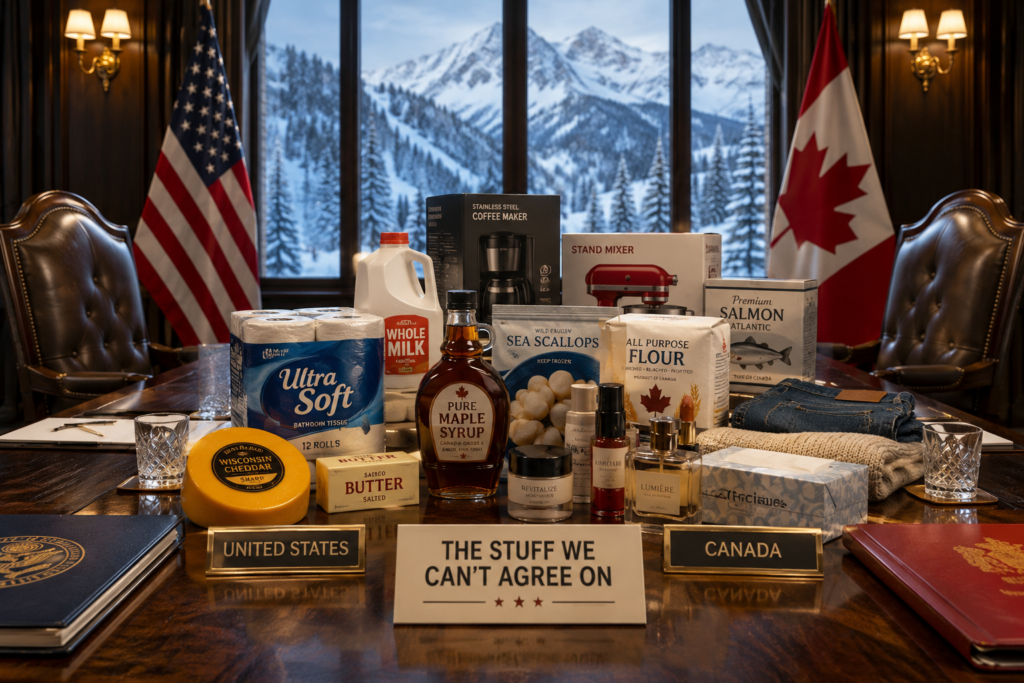
Canada’s response came fast and it came loud. Roughly $20 billion in U.S. goods now face retaliatory duties. More than 700 products made the list. Steel. Dairy. Appliances. Farm equipment. Clothing. Cosmetics. Seafood. And a whole lot of everyday items you didn’t think had foreign policy implications.
Toilet paper, people. We have reached the point in international relations where the Charmin Ultra Soft is now a geopolitical bargaining chip. Somewhere, a Canadian diplomat is sitting in a room right now, staring at a roll of two-ply, whispering, “You were always the strongest of us.”
What Trump’s 50% Tariffs Actually Mean for Your Wallet
Now, let’s talk about what this actually means for regular people, because that’s where the real comedy lives. Your average American doesn’t wake up thinking about trade policy. Your average American wakes up thinking about coffee, traffic, and whether they remembered to pick up groceries. And now, thanks to the miracle of modern diplomacy, even that simple routine is directly connected to international affairs. The coffee might be fine — unless it’s Canadian, in which case, congratulations, you’re now funding an international incident before 8 a.m. The traffic is still terrible, but at least it’s domestically terrible.
The White House’s framing, of course, is that Canada has been getting a “free ride.” A free ride. On what, exactly? The privilege of selling us cheese? The audacity of providing us with farm equipment so we can grow our own food? The sheer gall of manufacturing everyday goods — products, I remind you, that every single human being on Earth needs, unless they have made some very advanced lifestyle choices that I do not want to know about?
This is the “free ride” narrative, and it is meeting a very real invoice. That invoice includes 15%, 25%, and 50% tariffs matched to corresponding U.S. rates on specified goods. Which means that somewhere, right now, there is a spreadsheet — a very serious, government-issued spreadsheet — where someone had to decide whether a particular type of cheddar warranted a 25% or 50% retaliatory strike. That is someone’s job. That person went to college. They have a family. And today, they had to categorize cheese by its capacity to absorb economic warfare.
The Real Cost of a US-Canada Trade War
But let’s not pretend this is just about cheese. It’s about the principle. The principle being, apparently, that the best way to negotiate with your largest trading partner is to treat the entire North American economic relationship like a hostile takeover of a failing restaurant chain. “You think you’re gonna sell us appliances? Not without a 50% markup, buddy. You want us to buy your farm equipment? Fine, but we’re gonna need you to feel it where it hurts.”
And the beauty of it — the true, unvarnished, almost poetic beauty — is that this is happening between allies. Not enemies. Not rivals in some distant proxy war. Allies. Countries that literally have a treaty saying they will defend each other if attacked. A treaty that, I assume, does not include a clause about what happens if one ally decides to tariff the other’s cosmetics into oblivion, but maybe that’s in the fine print.
What does it mean when a U.S.-Canada dispute moves from negotiating rooms to hundreds of consumer and industrial product categories? It means that diplomacy has left the building, and in its place, we have a very expensive, very public, very stupid argument about who pays more for dairy. It means that the relationship between two nations that have historically defined themselves by their ability to get along — even when they don’t agree — has now been reduced to a pissing contest measured in percentage points and product lists.
Canada’s $20 Billion Retaliation List Reads Like a Shopping Cart
Let’s take a moment to appreciate the sheer range of products on Canada’s retaliation list, because it tells a story. Steel — okay, that’s industrial, that’s serious, that’s the kind of thing trade wars are supposed to be about. Dairy — now we’re getting personal, because Americans love their cheese, and Canadians know it. Appliances — suddenly your new washing machine is a geopolitical statement. Farm equipment — so now the people who grow our food are caught in the crossfire. Clothing — your T-shirt is now a tariff casualty. Cosmetics — hope you weren’t planning on looking good this fall. Seafood — dinner just got more expensive.
This is not a targeted strike. This is not a surgical economic intervention. This is a shotgun blast aimed at the entire concept of “things Americans buy regularly,” and Canada is standing there with the smoking barrel saying, “Yeah, we meant to do that.”
Who Pays the Price When Trump Tariffs Canada?
And let’s be clear about who actually pays. It’s not the governments. Governments don’t buy groceries — not personally, anyway, though I have questions about some of the budgets I’ve seen. It’s not the corporations, who will just pass the cost along like a hot potato in a game nobody wanted to play. It’s people. Regular people. The ones who are just trying to get through the week without their grocery bill requiring a second mortgage. The ones who don’t understand why their favorite Canadian cheese now costs as much as a used car. The ones who are going to walk into a store in September and find out that “trade war” isn’t just something that happens on cable news — it’s something that happens in aisle seven, right between the paper towels and the existential dread.
Imagine the conversations that are going to happen in American homes next month. “Honey, why is the toilet paper $47?” “Well, sweetheart, the president decided that Canada was getting a free ride, so now we have to pay a 50% tariff on bathroom supplies.” “But… it’s toilet paper.” “I know. Welcome to geopolitics.”
Or the farmer who needs a new tractor part. “Sorry, sir, that part is Canadian. It’s gonna be 25% more now.” “But I need it to grow food. For people. To eat.” “Yeah, the government knows. They just think Canada should pay more for the privilege of helping you not starve.”
This is the reality of trade war as consumer experience. It’s not abstract,, theoretical, nor something that happens in boardrooms or diplomatic cables. It happens in your bathroom, in your kitchen, in your closet, in your farm supply chain. It happens when you reach for a product and realize that the price tag now includes a surcharge for international spite.
Why September 8 Is the Worst Possible Timing
And the timing! The timing is chef’s kiss. These tariffs and retaliatory measures are set to take effect September 8. September 8! That’s not a policy implementation date; that’s a back-to-school deadline. That’s the week when parents are already stressed about lunchboxes and bus schedules, and now they get to add “will my grocery bill double because of a trade dispute” to the list of things keeping them up at night. Nothing says “we thought this through” like announcing a trade war that will hit consumer goods right as families are restocking their pantries for the fall.
So here’s where we are: America and Canada, two nations built on the idea that neighbors can disagree without destroying each other, have decided to test that theory by weaponizing household goods. The diplomatic relationship has entered its “don’t text me, tariff me” phase. And the rest of us? We’re just standing in the blast radius, holding a shopping list, wondering when exactly the world decided that toilet paper was the hill we were all going to die on.
God bless North America. And God help us all when the maple syrup gets involved.
—- Pepper